Wednesday, March 11, 2015

Architecture II--the Townhouse Design

By request, here is the second level architecture class townhouse assignment:

Yokana/Architecture II

                                    The Townhouse


You will be designing a townhouse.

Dimensions: 20’ x 50’
·      Two party walls that cannot be penetrated or moved.
·      Front to back orientation
·      Need public and private spaces
·      Some rooms MUST have access to light and air by code.
·      9’ ceilings
·      ¼ scale (1/4" equals 1 foot-use the scale rulers!)
·      Two floors

Program: (minimum dimensions)
·      Entry with closet (2’ depth)
·      Living room—15 x 20’ Needs natural light
·      Dining room—12 x 12’
·      Kitchen—15 x 10’
·      ½ bath—3 x 6’
·      2 Bedrooms—10 x 10’ Needs natural light and air
·      3 closets-2 in the master bedroom—2 x 3’
·      2 bathrooms—9 x 6’ (1 hall access and 1 master)
·      Hallways—3’ wide
·      Stair—3 x 13’ (13 linear feet with a 3’ platform at the top and bottom)(Spiral 8’ diameter)


Begin by working on ¼ scale graph paper and cut out the program spaces. Place them on the graph paper (like puzzle pieces) making three different solutions to the design problem.

Create a client. Who is the user for your design: a family of four? A middle-age career woman? A young man who has a good paying job? You need to design for someone-this is human centered design. Think about what tone, style and feeling you would like your design to invoke. 

Thursday, January 22, 2015

Friday, December 26, 2014

Designing Real/Experiential Courses for Students

It's been an amazing first almost half of the year.... I have met and worked with like-minded people, and talked to students who are crying out for a different type of education. After I gave the induction speech at my high school's honor society, several students stopped me in the hall to express their willingness to do something that mattered, but also to say that they just didn't have time. Our teenagers are so stressed and over-programed that they don't have time to seek meaningful experiences on their own time and they aren't being offered in schools.

To meet this need, we (Social Studies teachers Maggie Favretti, Jen Maxwell, Fallon Plunkett and I) designed a course, City 2.0,  which culminates in a semester long challenge which the students choose and solve using  Design Thinking. The course fits into the NY State requirement for Social Studies Public Policy. We knew that the culminating experience would be the self-selected challenge and we worked backwards from there. We asked ourselves what students would need in order to succeed with this challenge. They needed a lot of skills and habits of mind in order to be successful: resilience; the ability to ask questions and to seek help from appropriate sources, to name just a few. They needed to be able to work effectively with a team-in other words they had to able to lead, listen and collaborate-truly collaborate, not just divvy up the work. They also needed to know about the city. They needed to really study it: to break it apart and understand the complexities of its parts.

The Brooklyn Bridge area tile.
We created a series of scaffolded experiences that would allow students to understand by DOING and use Design Thinking. First there was a scavenger hunt that asked them to go places in the city and accomplish some tasks-all without a smart phone! Then they studied a block in depth. Next, they learned about infrastructure in preparation for building a scale model of lower Manhattan. Each group built a separate tile of the area-complete with subway lines and other infrastructure. These tiles will be put together on January 7th and students will participate in a day long challenge: Storm Godzilla. The students are all divided into disaster teams and will react to the situation as it develops. Real world people will be there to oversee the day: FEMA, the Coast Guard and the Office of Emergency Management. The students should be prepared to handle whatever comes there way-IF they have done their homework.
The ground level of one tile.

Students have said thus far that the course is exciting, different and hard. Not hard in that there is too much work or that it is difficult to comprehend, but hard in that you can't "fake it." Our students are so used to doing school, that they complete traditional assignments without truly understanding or embracing them. They go through the motions, knowing that if they do what a teacher wants, they will get a good grade. But they haven't learned anything and they haven't truly owned it. This course has challenged students in a new way. Most love it. A few don't-because they can't fake it.

Battery Park street level.
We need to challenge our students like this before their senior year. These skills and habits of mind need to be part of their schooling from the beginning, not just as a culminating experience. Let's design authentic experiences for them. Let's empower them. Let's help them learn how to use their education to make the world a better place.

Let us know what you come up with and reach out if you need help! And check out ways to design these types of experiences here http://www.edutopia.org/blog/capture-learning-crafting-maker-mindset-lisa-yokana?utm_source=twitter&utm_medium=post&utm_campaign=blog-crafting-maker-mindset

Monday, November 3, 2014

Connecting to Like Minded Maker/Educators

Last week, I went to an amazing conference. Amazing because I met like-minded people, networked like crazy, heard and saw new things and came away filled to the brim with excitement. Bottom line: I no longer felt like one of a few people who believed that making and doing are the way to teach students. The conference: the https://entrepreneurship.asu.edu/makersummit/ at ASU, brought together the 153 colleges and universities that took the maker pledge. These schools agreed to do one or more of the following:
  • Allowing students that are applying for admission to submit their Maker portfolio
  • Investing in Makerspaces that are accessible to students across the campus, or serving as “anchor tenants” for commercially-operated Makerspaces
  • Supporting education, outreach and service-learning that is relevant to Making, such as encouraging students to serve as mentors for young Makers
  • Supporting research that advances making technologies and facilitates greater access to making experiences such as the development of new tools for desktop manufacturing
  • Expanding access to university shared facilities and scientific instrumentation to Makers
  • Encouraging students to use their senior design projects to experiment with Making and Maker-preneurship
  • Providing scholarships to students based upon excellence in making
  • Participating in regional efforts to create a vibrant Maker ecosystem that involve companies, investors, skilled volunteers, state and local officials, libraries, museums, schools, after-school programs, labor unions, and community-based organizations
Wow! 153 higher ed institutions believe in this. And it's not just STEM schools, Bucknell is one of those schools and they understand how this includes the liberal arts and must be interdisciplinary. So if you are connected to a higher ed institution which is not one of the 153 thought leaders, exert your influence as an alum. If colleges and universities get it, then it makes it easier for high schools to get buy in from parents and students. Parents will see that it's ok for their children to make things, and that they will still get into college. Maker portfolios are here. Let's start creating them!

Friday, October 17, 2014

Do Something-NOW!

The following is the speech I delivered to the Honor Society at their induction of new members this past Wednesday night. It needs no other introduction....

It is truly an honor to be asked to speak to you tonight and I would like to thank Signifer for the invitation. This is an exciting night and you are all to be congratulated on your achievement. You have worked hard; persevered through obstacles; put schoolwork first; and given up some things that would probably have been more fun in order to receive this honor. And while grades do matter, they are only one measurement of your abilities. But I know it is no small accomplishment to get here. Along the way, I am fairly sure you have had weeks where you thought you could not possibly get through all the work you had, or come up against an assignment that was truly difficult for you. And you figured out how to get through those challenges: you reached out to teachers or peers to get help; you dug down deep and stuck with it. You have shown that you have grit and perseverance. These qualities will be ones you call on again and again in your lives when the going get’s tough, and I’d like to mark tonight as an acknowledgement of those qualities. You will need them as you face the challenges and problems of the 21st century.

For the world has changed since I graduated from high school. You all hold more knowledge in your hands-in your smart phones-than is contained in all the textbooks published in my lifetime. The world is at your fingertips and you have the ability to connect with information and people from across the globe. I know that this wealth of information and the speed with which it is available can be overwhelming sometimes. It is easy to get lost in that and loose sight of the bigger picture.  But it is also creates opportunities that were unthinkable in my day.  If you want to know something, you just have to figure out how to ‘Google it.’

But what good is all this knowledge and connectivity if you don’t use it? The concept of Open Source has made information and research available that was previously privileged. It allows for large-scale collaboration across the globe. Crowdfunding gives inventors the chance to actually get their ideas funded and built. Democratizing access to information has changed the way that new products and technology are created and allows innovation to happen at an amazing pace.

You have opportunities all around you. I know you are busy, doing school. You have your eye on the end goal-that college acceptance letter. But do not let that be the sole criteria for how you spend the rest of your time at Scarsdale High School. Take advantage of the people around you. We are all here to help you define your interests and passions and achieve your goals. But don’t aim too low. Have high standards for yourself. Yes, getting into that great college is amazing, but don’t let it be all you strive for. I don’t want you to look back at high school and realize that’s all it was about. Because if you think of this moment in your life as the pinnacle of your achievement, if you take this award and do nothing more than put it on a shelf in your room to collect dust-another knick-knack along with those soccer trophies or swimming ribbons-then this honor has been wasted on you. You are all here because you cared enough to work hard and to value your education, but your intelligence is useless if you now rest on your laurels.

So, I would like to issue you a challenge this evening. From this moment on, I want you to consider it your responsibility to take that grit, that intelligence, and that knowledge and go out into the world and make change. Be curious about the world and its problems; take time to wonder, look for opportunities to make things better. Improve the world.  Don’t wait.  There are problems and needs right now. Take advantage of senior options-do something real. Don’t settle for working at an elementary school because it’s easy. If you need help, come see me and I’m happy to give you some concrete suggestions. There are things that need fixing here or just a few blocks from here. DO SOMETHING NOW!

The future is complex and filled with difficult, multi-disciplinary challenges. If you choose to sit back and let others solve them, then you have failed us-your teachers, your parents and your peers. But if you choose to look around you, identify needs, see problems, and look for solutions, then you will be using your education and your intelligence productively. It won’t be easy and you will fail--a lot. And failure isn’t something with which most of you here are comfortable. But it’s a key ingredient in success. You will be discouraged and feel like quitting sometimes, but I hope you will remember this night and know that we believe in you and your ability to persevere.  You’ve proved it. And I’m hopeful. I know that you will take my challenge seriously. That’s who you are. You are our future. And from where I’m standing right now, the future looks bright. So, remember tonight as a milestone that acknowledges your achievements, but also remember it as the beginning of something special: a mindset that allows you to look around you, examine problems and identify needs. Don’t wait for someone to give you an assignment-I’m pretty sure Steve Jobs wasn’t given an assignment to create the iPhone. Don’t wait until you are in college or worse yet until after college. Use your skills, your resilience and grit to tackle something real NOW and keep trying until you’ve made a difference.


Friday, September 26, 2014

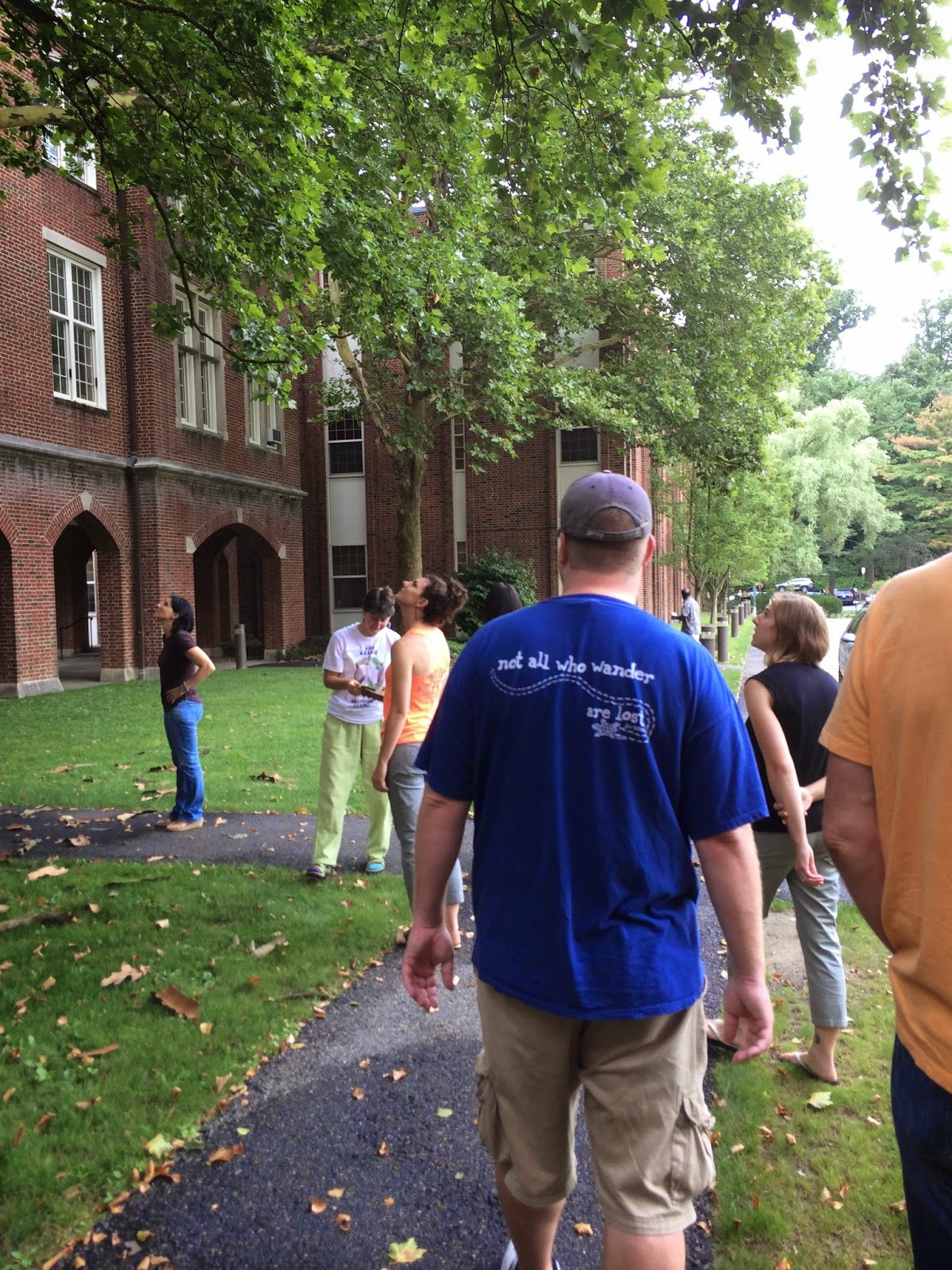
'Wander and Wonder'-Taking Time to Notice

I began all my classes this year with a 'Wander and Wonder.' Students followed me through the school and outside, silent and without phones. Eventually, we all returned to the classroom perhaps ten minutes later. Their instructions were simple: don't talk, look around you-simply notice. Of course, some of them thought I was that crazy art teacher. They thought it was funny or silly. But some of them really enjoyed it. I realized that this week when one of my freshmen asked, "Are we going to do that walking thing again?" "Why," I asked? "Because it was cool," he answered. "We never get time to slow down and look at stuff." Wow, he got it.

Their lives, all of our lives, are so fast-paced and crazy. There is so little time to slow down and look around you. I'm addicted to my cell phone, so I know. I heard a story on NPR that said the average person checks their cell phone 150 times a day. I thought, wow, is that all? I check mine way more than that! There is so much competing for our attention these days that we rarely get to focus on one thing.

I've banned phones from my classroom, except when I give them permission to look something up. It's a habit-multi-tasking. I think our students need time and spaces where they unplug, and my classroom is one of those spaces. I want them to be involved in the process of being creative and that definitely takes time and their full attention. It's also a habit you can build. Creativity doesn't always come like a light bulb. It usually takes struggling and playing with materials and ideas. It takes time and focus. So another 'Wander and Wonder' will definitely happen soon. Perhaps when they are particularly fidgety or unfocused. I think we will do them many times during the year, just to see if it gets easier for my students.
Wander and wondering with a Teacher Class this summer!

Monday, July 28, 2014

Making a Make Shift Makerspace


We measured the garage and I went to Ikea and bought four tables. We cleaned out the back of the garage and then organized the workbenches so that tools were handy but it wasn't cluttered.
We fixed the lighting. The dog helped....


Now we have a place in our garage where we can make things! It's not rocket science, really. It's furniture that is functional in a space where you are free to make a mess; where you can leave things out and not clean up; where tools are nearby and easy to find; where there is stuff that inspires you as you are making things.


Next we looked for some inspiration. First, we went to visit a former student of mine, Giancarlo Paternoster, http://giancarlopaternoster.com/, who makes beautiful high-end furniture in his basement workshop.


Next, we went to the Brooklyn Museum to see Ai Wei Wei's show, "According to What?" http://www.brooklynmuseum.org/exhibitions/ai_weiwei/


That's all it takes to make a Makerspace and be inspired.... It's not rocket science after all....